

ROCK SLOPE STABILIZATION OF THE HISTORIC CENTRE OF CASTIGNANO
Challenge
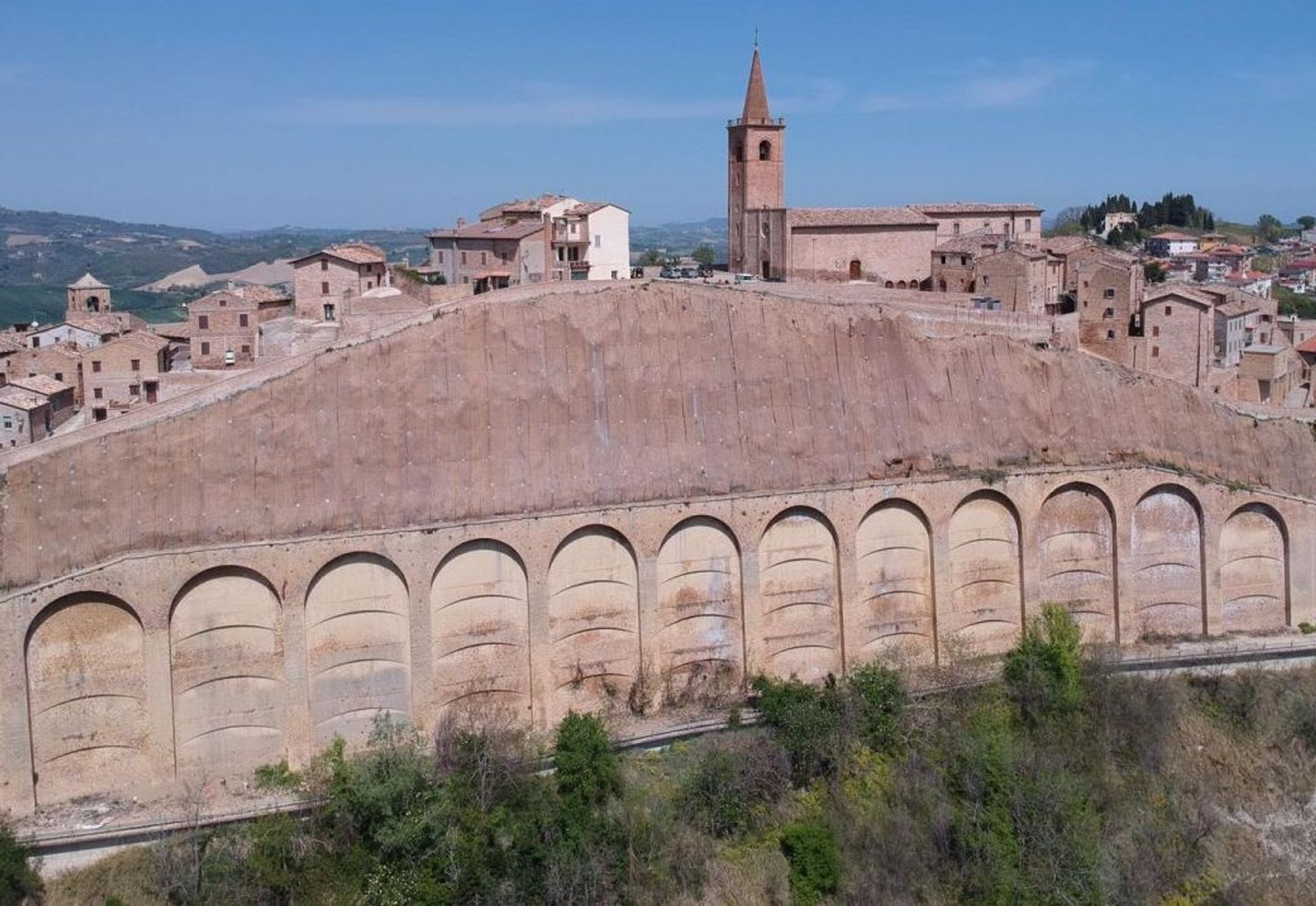
The study area lies on the southern side of the sandy ridge on which the historic center of Castignano stands, immediately uphill from the arched retaining wall supporting the southern slope of the sandy cliff.
The cliff supporting the historic center of Castignano consists of Lower-to-Middle Pliocene sandstone turbidites, represented by well-stratified sands, with clay layers mainly located in the lower part of the formation.
The slope stability conditions are influenced by the degree of weathering of the sandy layers. Except for the outer surface band, which has an average thickness of about 2.0 m, these materials are highly compact and partially cemented and therefore generally ensure stable equilibrium conditions.
The weathering action caused by exogenous agents, particularly effective along the middle-to-upper section of the slope that is not protected by the retaining wall, has led to the deterioration of the outer sandy formation, resulting in the development of eroded and fractured wedges in precarious equilibrium conditions.
Due to the steep slope gradient and the tectonic characteristics of the area, the ongoing instability develops through two main phenomena: the retreat of the upper edge of the slope, with frequent collapses of portions of it, and the fall of rocks and debris onto the road below, posing a clear risk to people and property.
This phenomenon endangers the infrastructure and buildings of the historic center, which are located directly along the edge of the slope.
Solution
In order to protect the buildings of the historic center of Castignano and secure the road located below the cliff, a stabilization intervention was carried out on the upper portion of the sandy slope not supported by the existing wall. The works involved a surficial reinforcement system using Steelgrid HR30, anchored to the stable substrate with passive nails, together with the installation of a biomat to provide additional erosion protection.
Our products for
this Success Story

Get in touch with us
[contactForm_txtSuccessSubmit]