2020
ROCHDALE - GREATER MANCHESTER - United Kingdom
ROCHDALE MBC
Temporary Bridge Diversion on Soft Ground Using Paralink Basal Reinforced Platform (BRP) Solution
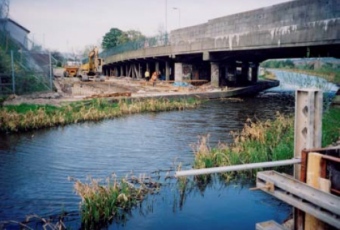
Existing concrete framed bridge structure with temporary diversion route
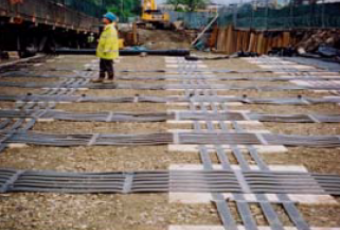
Installation of the ParaLink
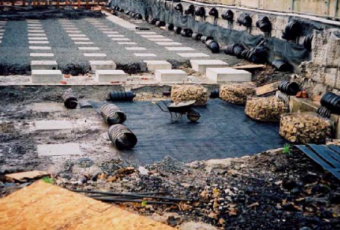
Interface between temporary and permanent roads. Showing Gabion Terramesh partit
Challenge
A reinforced concrete bridge structure required full replacement, including the construction of a new bridge and associated approach embankments, to supersede the existing viaduct. A critical constraint of the project was the need to maintain uninterrupted traffic flow throughout the construction period. To achieve this, a temporary diversion road and bridge were necessary, to be constructed immediately adjacent to the existing structure while demolition and new works progressed.
The site conditions presented significant geotechnical challenges. The available footprint for the temporary road was highly restricted, and the underlying ground conditions consisted of peat deposits overlying soft clays, both of which are unsuitable for supporting conventional embankment loads. These factors necessitated the use of a piled Basal Reinforced Platform (BRP) to ensure adequate load distribution and stability.
Further complexity arose from the fact that part of the temporary road alignment would ultimately lie beneath the shoulder of the permanent embankment. This required the BRP design to accommodate both temporary and permanent loading conditions. The reinforcement system therefore needed to provide long-term support beneath the permanent structure, while also allowing for redundancy or potential removal in areas associated only with the temporary diversion. Balancing these overlapping requirements within tight spatial and ground condition constraints posed a significant engineering challenge.
Solution
Maccaferri developed an alternative solution to the originally proposed multi-layer blanket system by introducing the Paralink strip reinforcement system. Working in collaboration with Stent Piling, Maccaferri also proposed a revised piling layout integrated with a strip-based BRP design. This approach was subsequently supported by Galliford Northern and received approval in principle from the client.
The Paralink strip system provided a key advantage in constructability and performance. Its configuration allowed the primary transverse reinforcement elements to be threaded between the support columns of the existing bridge structure. This enabled continuity of the reinforced platform beneath the footprint of the permanent embankment, ensuring long-term structural integrity while accommodating the constraints imposed by the temporary works.
In addition to the basal platform, the scheme required a vertical retaining structure approximately 2.5 metres in height to support the temporary road, which was positioned above the level of the permanent embankment. Maccaferri incorporated a Gabion Terramesh reinforced soil structure into the overall design, effectively integrating the retaining function with the BRP system and maintaining stability under the temporary loading conditions.
The durability and robustness of the Paralink system were also critical to the success of the solution. The strips are manufactured with a tough protective coating, allowing them to be installed in direct contact with pile caps without risk of damage from sharp edges or degradation due to the alkaline environment of concrete. This eliminated the need for additional protective measures, simplifying installation and ensuring long-term performance.
Overall, the proposed solution addressed the combined challenges of poor ground conditions, limited space, and the need to maintain traffic flow, while delivering a cost-effective and technically robust alternative to the original design.
Used Products