2008
Glasgow, Scotland
St Andrew's Homes (Scotland) Ltd
St Andrew's Homes (Scotland) Ltd
Maccaferri Ltd
Space-Efficient Retaining Wall Design Using MSE and Geosynthetics for Restricted Sites
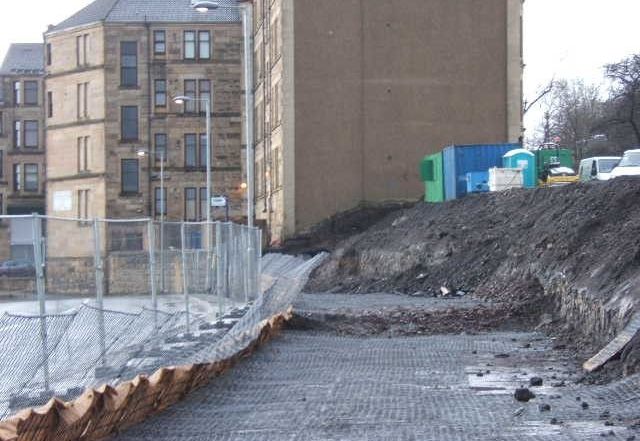
Detail of Green Terramesh® unit
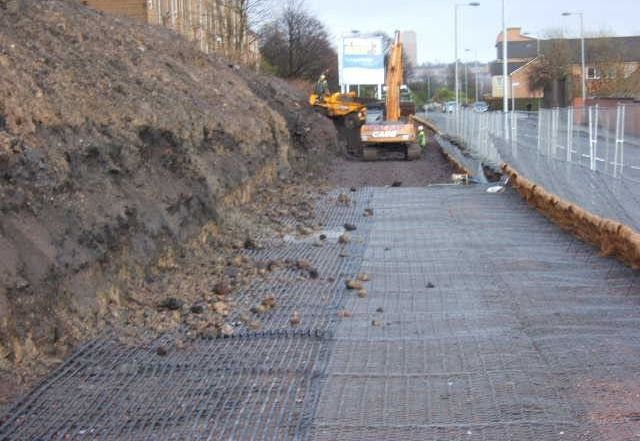
Green Terramesh® geogrid installation
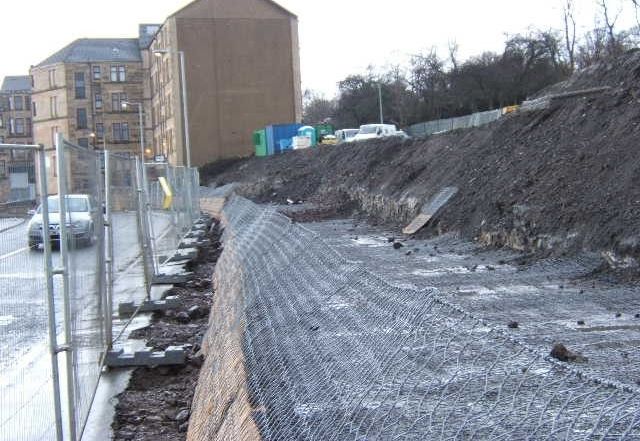
First Green Terramesh® layers being installed
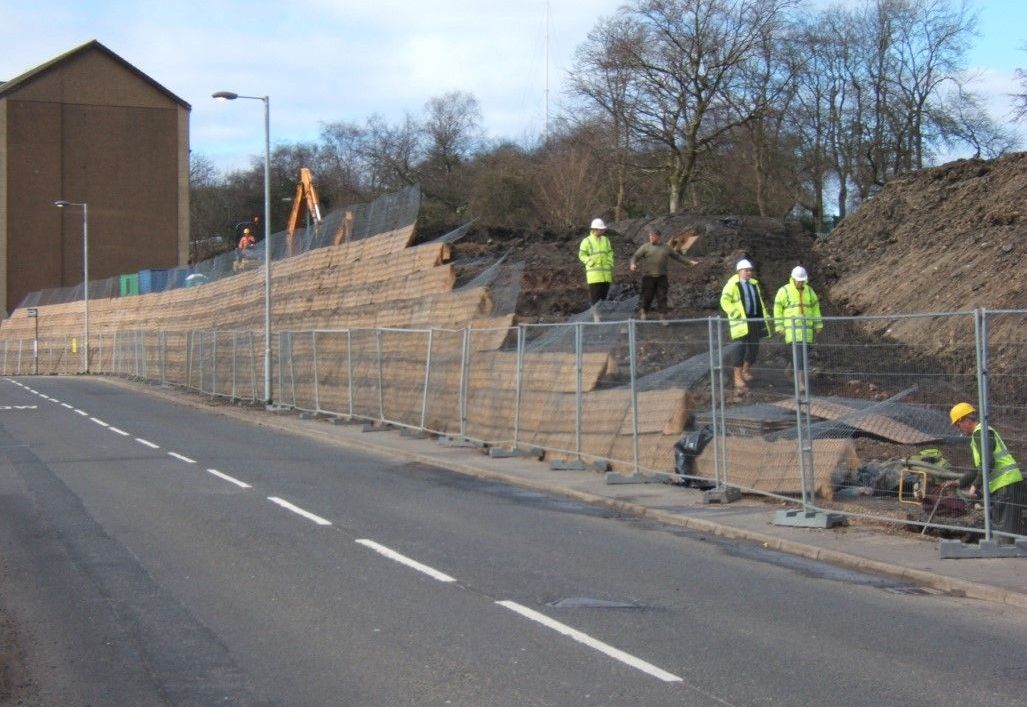
Structure nearing completion
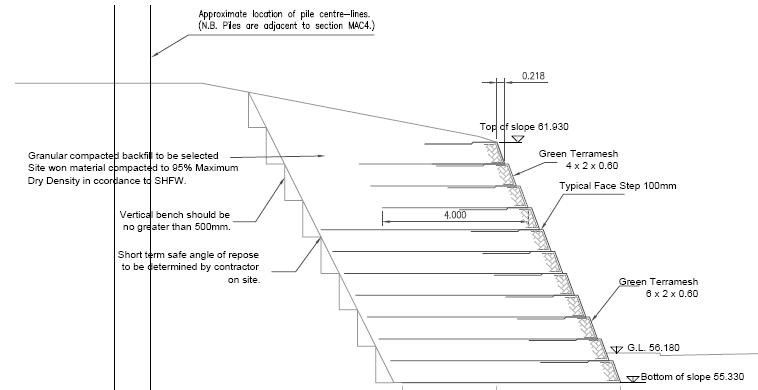
Typical cross section
Challenge
The project faced significant constraints due to a limited site footprint and the requirement to accommodate safe access for heavy goods vehicles. Conventional embankment construction methods were not feasible, as they would have required a much larger area than was available. The presence of adjacent infrastructure, including a bridge section and tipping hall access point, further increased the complexity, demanding a compact yet robust retaining wall solution.
In addition to spatial limitations, challenging ground conditions posed a major engineering concern. The site comprised glacial tills overlain with unsuitable made-ground, requiring careful management of structural backfill materials. Minimising waste, reducing the need for imported fill, and limiting off-site disposal were key project objectives from both environmental and cost perspectives.
Solution
To overcome these challenges, Arup designed a space-efficient curved access ramp using a reinforced soil retaining wall system. The solution incorporated Maccaferri MacRes® precast concrete retaining wall panels, forming two opposing vertical walls that significantly reduced the footprint compared to traditional embankments.
The structure was stabilised using PARAWEB® geosynthetic reinforcement straps, creating a mechanically stabilised earth (MSE) system. This type of reinforced soil structure is widely used in infrastructure projects such as motorway bridge ramps due to its high load-bearing capacity, durability, and flexibility in design. The curved, double-sided ramp allowed the structure to fit within the restricted site while ensuring safe and efficient vehicle access.
At the top of the ramp, the MacRes® retaining wall system also provided critical support for the bridge bank seat located adjacent to the tipping hall, demonstrating the versatility of the solution in integrating multiple structural functions.
Maccaferri Construction delivered the project under an indemnified design, supply, and installation contract for main contractor CNIM/Clugston JV. This integrated approach ensured a high-quality, cost-effective retaining wall solution tailored to the project’s geotechnical and operational requirements.
In addition, Maccaferri designed a 180-metre-long reinforced soil slope using Green Terramesh® units combined with Paragrid geogrids. These modular, pre-assembled units were delivered flat-packed and installed by Allma Construction in 600 mm high and 2 metre long sections. Stacked sequentially, they formed a reinforced embankment with a retained height ranging from 4.8 metres to 6.6 metres.
A key advantage of this solution was the use of site-won soils as structural backfill. By selectively reusing glacial tills found on-site, the project significantly reduced the need for imported materials and minimised waste. The material was compacted in layers over geogrid reinforcement tails—6 metres long in the lower sections and 4 metres in the upper sections—ensuring structural stability while enhancing sustainability.
This approach delivered substantial environmental and economic benefits, including reduced haulage, lower carbon impact, and minimal off-site disposal, making it a highly efficient and sustainable retaining wall and embankment solution.
Used Products