2022
Crickheath, Shropshire
Montgomery Canal Restoration Ltd
Montgomery Canal Restoration Ltd
N/A
Montgomery Canal Restoration Sustainable Bridge and Retaining Wall Solution
Challenge
The Montgomery Canal, originally constructed between 1794 and 1821, stretches 33 miles from Frankton Junction in Shropshire to Newtown in Powys. Once a vital transport route for wool and limestone between England and Wales, the canal fell into disuse after a breach in 1936 and was officially closed in 1944. Since 1969, an ongoing restoration programme has aimed to bring this historic waterway back into operation for tourism, leisure, and heritage preservation.
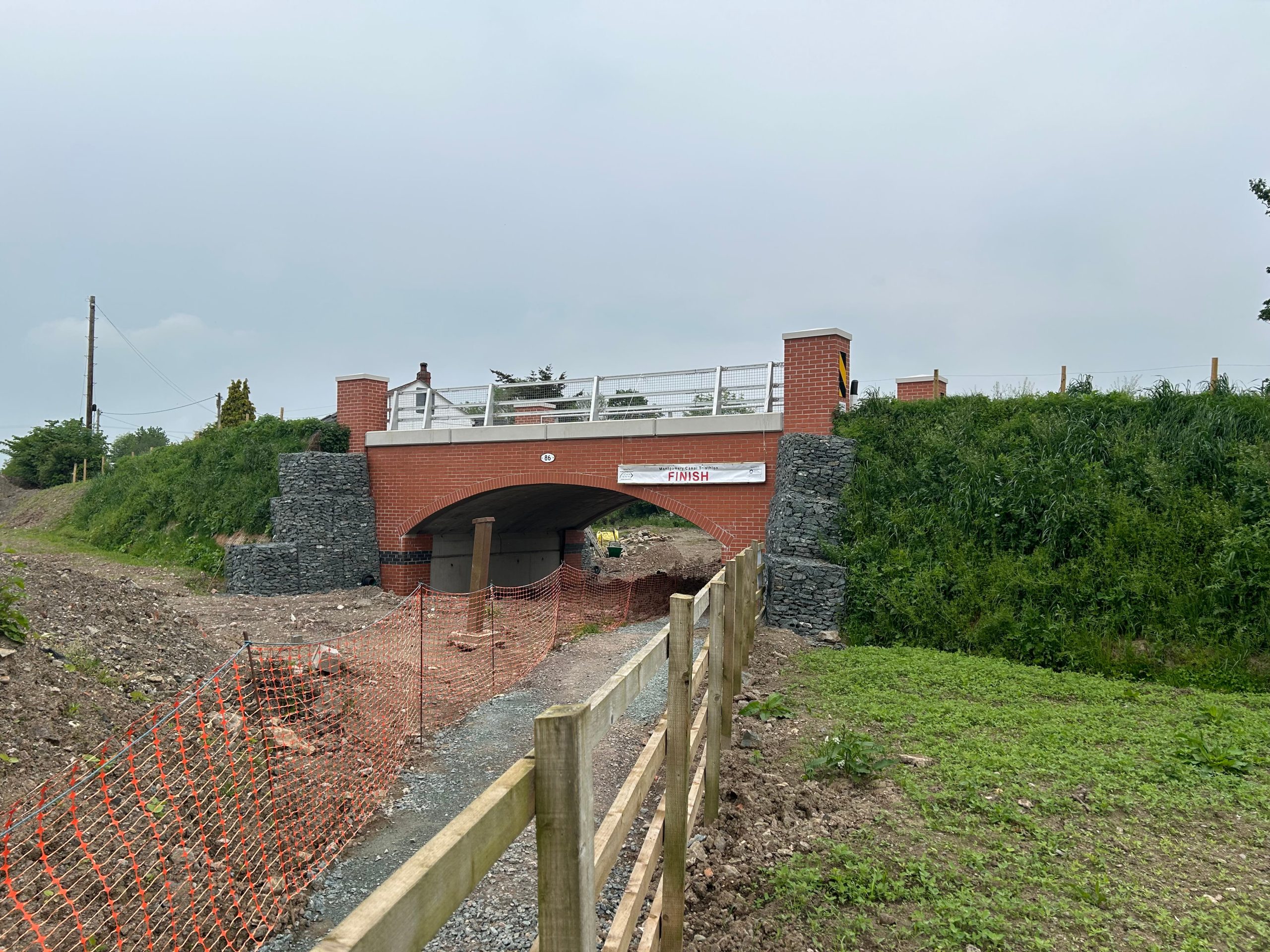
A major obstacle in the restoration of the canal in Shropshire was the loss of Schoolhouse Bridge. Demolished in the late 1960s and replaced with an earth causeway, the structure blocked the canal and prevented the reopening of the final dry section. Reinstating this bridge became essential to restoring navigation and reconnecting the canal.
Montgomery Canal Restoration Ltd was tasked with delivering a new bridge that met modern engineering standards while respecting the canal’s heritage. The project required compliance with current highway design criteria, including vertical and horizontal alignment, as well as sufficient headroom to allow canal boats to pass beneath the structure.
To achieve the necessary clearance, the approach roads needed to be raised by approximately one metre. This created the need for robust retaining wall solutions, including bridge wingwalls and highway embankment support. Additionally, the entire structure was required to achieve a 120-year design life, ensuring long-term resilience and sustainability in response to climate change.
A key challenge was to deliver these retaining structures using low-carbon, environmentally sustainable materials, aligning with modern infrastructure and environmental standards.
Solution
Maccaferri was engaged to design and supply sustainable retaining wall solutions for the new bridge and raised highway embankments. The objective was to deliver a durable, cost-effective, and low-carbon solution that met the project’s 120-year design life requirement.
The Terramesh reinforced soil system was selected for the highway embankments and three of the bridge wingwalls. For the fourth wingwall, located in a constrained excavation near Long Lane, Double Twist gabions were used as a mass gravity retaining structure.
For the embankments, Green Terramesh was specified. This vegetated reinforced soil system, installed at a 70-degree face angle, allowed the reuse of site-won granular fill from the excavated causeway, reducing material import and lowering the project’s carbon footprint. At the top of the embankments, reaching heights of up to 3.8 metres, the system was constructed in a back-to-back configuration to provide vehicle restraint and edge protection while maintaining a natural, landscaped appearance.
For the bridge wingwalls, Gabion Terramesh was used, offering a near-vertical 85-degree face and a natural stone finish. This enabled seamless alignment with the bridge abutments while maintaining structural integrity and visual consistency with the surrounding rural environment.
The final wingwall, constructed within a 3.5-metre-deep excavation, utilised Double Twist woven mesh gabions. To improve construction efficiency and safety, contractor Beaver Bridges Ltd pre-filled the gabion baskets off-site and lifted them into position using a crane, minimising time spent working in confined excavation conditions.
All systems incorporated Maccaferri’s advanced Polimac polymer coating, providing enhanced durability and corrosion resistance. This ensured a certified design life exceeding 120 years, meeting stringent long-term performance requirements.
The project delivered significant environmental advantages compared to traditional concrete retaining wall solutions. The use of gabions and reinforced soil systems resulted in up to a 90% reduction in embodied carbon, supporting the project’s low-carbon objectives.
The open stone structure of the gabions promotes biodiversity by creating habitats for plants and wildlife, allowing the structures to integrate naturally into the surrounding landscape. Locally sourced stone was used wherever possible to reduce transportation emissions and fuel consumption.
In addition, the Green Terramesh vegetated embankments actively contribute to carbon sequestration, capturing approximately 7.5 tonnes of CO₂ per hectare per year over the structure’s lifespan.
Used Products