


Mine Workings Stabilisation Using High-Strength Geogrids
Challenge
The development site was located on ground underlain by historic mine workings within a limestone layer of the Upper Oil Shale Group, dating back to the Carboniferous Age. In this region, the limestone seam is known to be particularly thick, increasing the geotechnical risks associated with legacy mining activity.
A detailed mining risk assessment identified that the seam had last been worked in 1898. Subsequent intrusive ground investigations confirmed the presence of significant underground voids, measuring up to 10 metres in thickness in certain areas. These open voids posed a high risk of ground collapse and surface subsidence, making the site unsuitable for conventional development without ground stabilisation.
To mitigate these risks, it was recommended that the affected area be sterilised and reinforced using a high-strength geosynthetic solution capable of preventing collapse mechanisms from propagating to the surface.
Despite the challenging ground conditions, the developer planned to transform the sterilised area into a functional and attractive public space. The design included a children’s play area, landscaped earth mounds, and a Sustainable Drainage System (SuDS) pond to manage surface water runoff. This required a robust ground engineering solution capable of supporting variable loads and complex topography while ensuring long-term stability and safety.
Solution
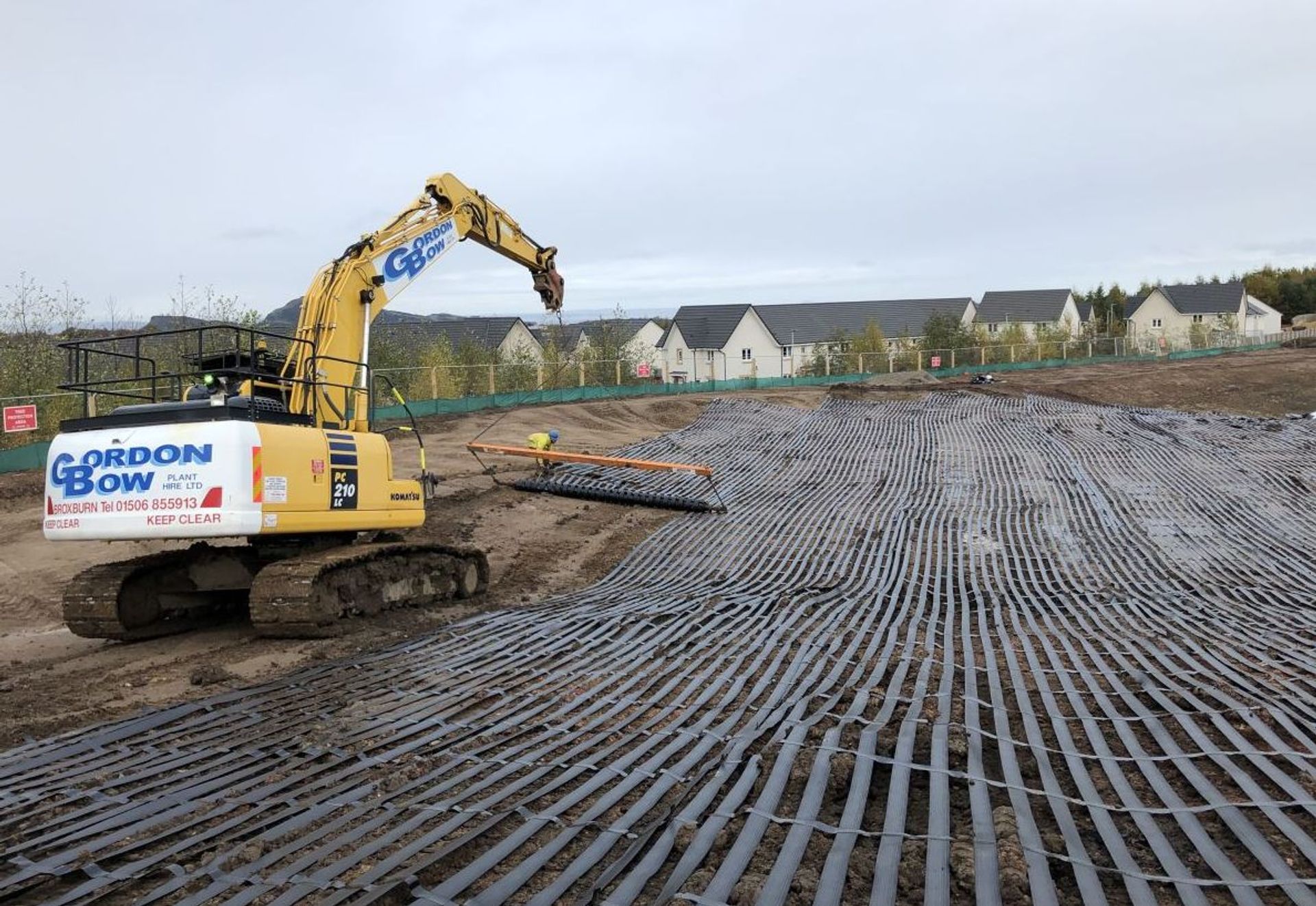
To address the challenges of building over mine workings, the developer’s engineer appointed Maccaferri to design and supply a high-strength geogrid reinforcement solution. Given the complexity of the site layout, which featured slopes, earth mounds, a SuDS pond, and interconnected footpaths, a detailed and site-specific design approach was essential.
Maccaferri utilised advanced 3D modelling techniques to create a digital representation of the site. This allowed for precise analysis of loading conditions, terrain geometry, and ground behaviour. Through this process, two distinct zones were identified, enabling the optimisation of the geogrid design by specifying different strength requirements tailored to local ground conditions.
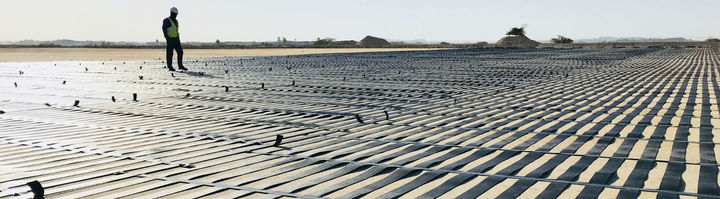
The solution incorporated ParaLink®, a high-performance geogrid known for its exceptional tensile strength and low creep characteristics. Due to its unique material properties and manufacturing process, ParaLink® allows for lower material partial safety factors compared to conventional geogrids. This engineering advantage enabled a more efficient and cost-effective design.
The final design utilised 200kN and 400kN strength geogrids, significantly reducing material requirements compared to alternative solutions that proposed a uniform 600kN geogrid across the entire site. This optimisation delivered substantial cost savings while maintaining safety and performance. The design was carried out in full compliance with BS8006-1:2010+A1:2016, the standard for reinforced soil structures..
Our products for
this Success Story
Get in touch with us
[contactForm_txtSuccessSubmit]