2025
Rugby
Stantec
Winvic
Lightweight Reinforced Soil Embankment Protects Critical Gas Main at Coton Park
Challenge
As part of the construction of a new state-of-the-art warehouse facility at Coton Park, Rugby, a significant ground engineering challenge arose. The development required the installation of a new road over a 54-metre-long culvert and an existing gas main. To mitigate the risk of excessive loading on the gas main, expanded polystyrene (EPS) lightweight blocks were selected to form the road structure and act as mass void fill above the buried services. Traditional construction methods were deemed unsuitable due to the imposed loadings they would transfer to the gas main, potentially compromising its integrity.
While EPS provided an effective lightweight solution, its low density meant it required confinement and sufficient overburden to prevent movement. This created the need for a substantial embankment structure to retain and cover the blocks. The design called for a 45-degree slope, rising to a height of 8 metres and extending 44 metres in length, effectively forming a large mechanically stabilised earth (MSE) embankment around the EPS.
A further complication was the nature of the available site-won material. Ground investigation reports, including borehole and ground information data, identified the soils as predominantly clay and sandy boulder clay with occasional pockets of sand and gravel. The project team aimed to reuse this material within the MSE structure to minimise both the importation of alternative fill and the export of excavated soils. However, cohesive soils of this type can present drainage and stability challenges, particularly when constructing steep slopes, and careful consideration was required to ensure adequate bearing capacity, global stability, and long-term performance.
Solution
A collaborative design approach was adopted to address the technical and environmental challenges. Maccaferri was responsible for the internal reinforcement design and facing elements of the MSE slope, while Stantec undertook the analysis of bearing capacity and global stability to ensure the overall integrity of the structure.
To enable the use of the site-won clay-based materials within a steep 45-degree embankment, Maccaferri incorporated multiple layers of ParaDrain geogrids into the design. These high-performance geogrids provided the necessary tensile reinforcement to stabilise the cohesive soils while also facilitating drainage within the reinforced soil mass. The integrated drainage capability of ParaDrain helped to relieve pore water pressures, a critical consideration when working with clay and boulder clay materials.
To further enhance drainage performance, MacDrain drainage geocomposite was installed at the rear of the structure. This system captured excess moisture from the retained ground and directed it into its drainage core, where it could be filtered away safely. By effectively managing groundwater and pore water pressures, the combined geogrid and geocomposite solution ensured both short-term constructability and long-term stability.
The adoption of this reinforced soil solution enabled the reuse of readily available on-site material, significantly reducing the need for imported engineered fill and the export of unsuitable soils. This approach delivered measurable environmental and commercial benefits, including lower carbon emissions associated with transport, reduced material costs, and a shortened construction programme.
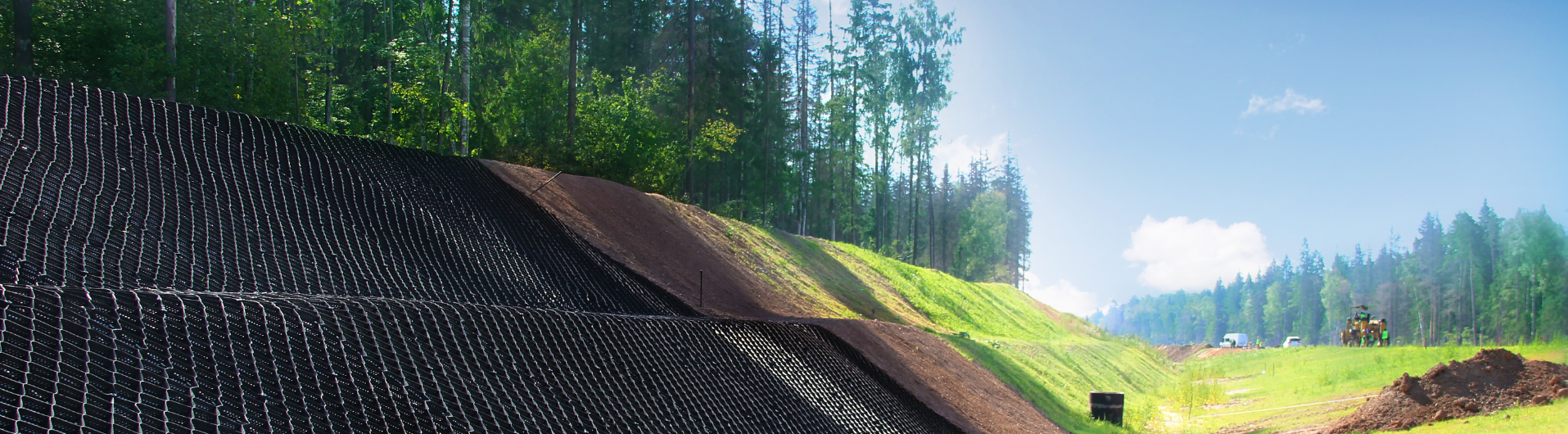
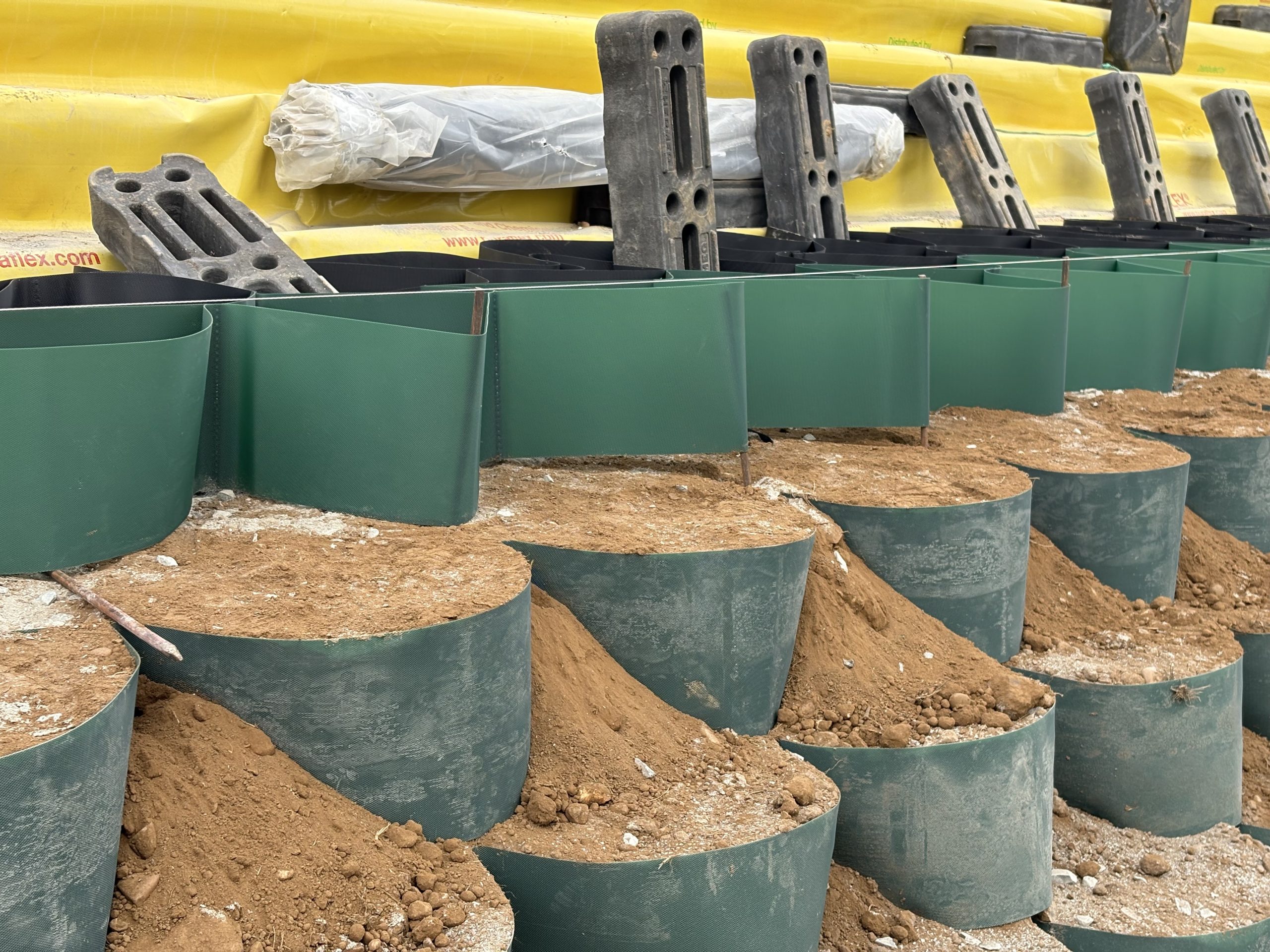
In response to the client’s requirement for a natural, green finish, a 100 mm MacWeb cellular confinement system was installed on the 45-degree slope face. The MacWeb was securely pinned to the embankment and infilled with topsoil to support vegetation growth, creating an aesthetically pleasing and environmentally integrated solution.
Finally, a post-and-rail fence was required at the crest of the embankment for safety and boundary definition. The fence posts were concreted through the upper two layers of ParaDrain reinforcement, with careful detailing to maintain the structural integrity of the reinforced soil system.
Through an integrated design process and the strategic use of reinforced soil and drainage technologies, the project successfully delivered a stable, sustainable embankment solution that protected critical buried infrastructure while meeting environmental, aesthetic, and programme objectives.
Used Products