


BELFAST HARBOUR
Challenge
The construction of a 480 m long quay structure and deep-water berth at the Port of Belfast posed major geotechnical and engineering challenges due to extremely poor ground conditions across a 50-acre brownfield site. The land, located within Belfast Harbour near George Best Belfast City Airport and the Titanic Quarter, required extensive stabilisation before it could support a £50 million trans-shipment and storage facility for the offshore wind sector.
This large-scale infrastructure project, developed as part of a joint venture between Dong Energy and Scottish Power Renewables, was critical to supporting the West of Duddon offshore wind farm. The facility was designed to handle, store, and assemble oversized wind turbine components, requiring the use of heavy tracked cranes and high-capacity handling equipment. These operations imposed extreme load conditions on the ground, making soil stabilisation and load distribution essential.
The quay structure itself added further complexity. It consisted of a combi-wall system using 1600 mm diameter tubular piles up to 32 m long, combined with 22 mm sheet piles. The structure was tied back to an anchor system supported by 376 raking piles, each 30 m in length. Additionally, a 17,000 m² quay slab was supported by 780 CFA piles of 750 mm diameter. Without significant ground improvement, the underlying soils would not have been capable of supporting these structural and operational demands.
Solution
A comprehensive ground engineering solution was implemented, combining dredging operations, structural support systems, and large-scale geosynthetic installation. Dredging works removed approximately 500,000 m³ of material from the new berth and approach channels, with suitable material disposed of at sea and contaminated material treated and disposed of on land.
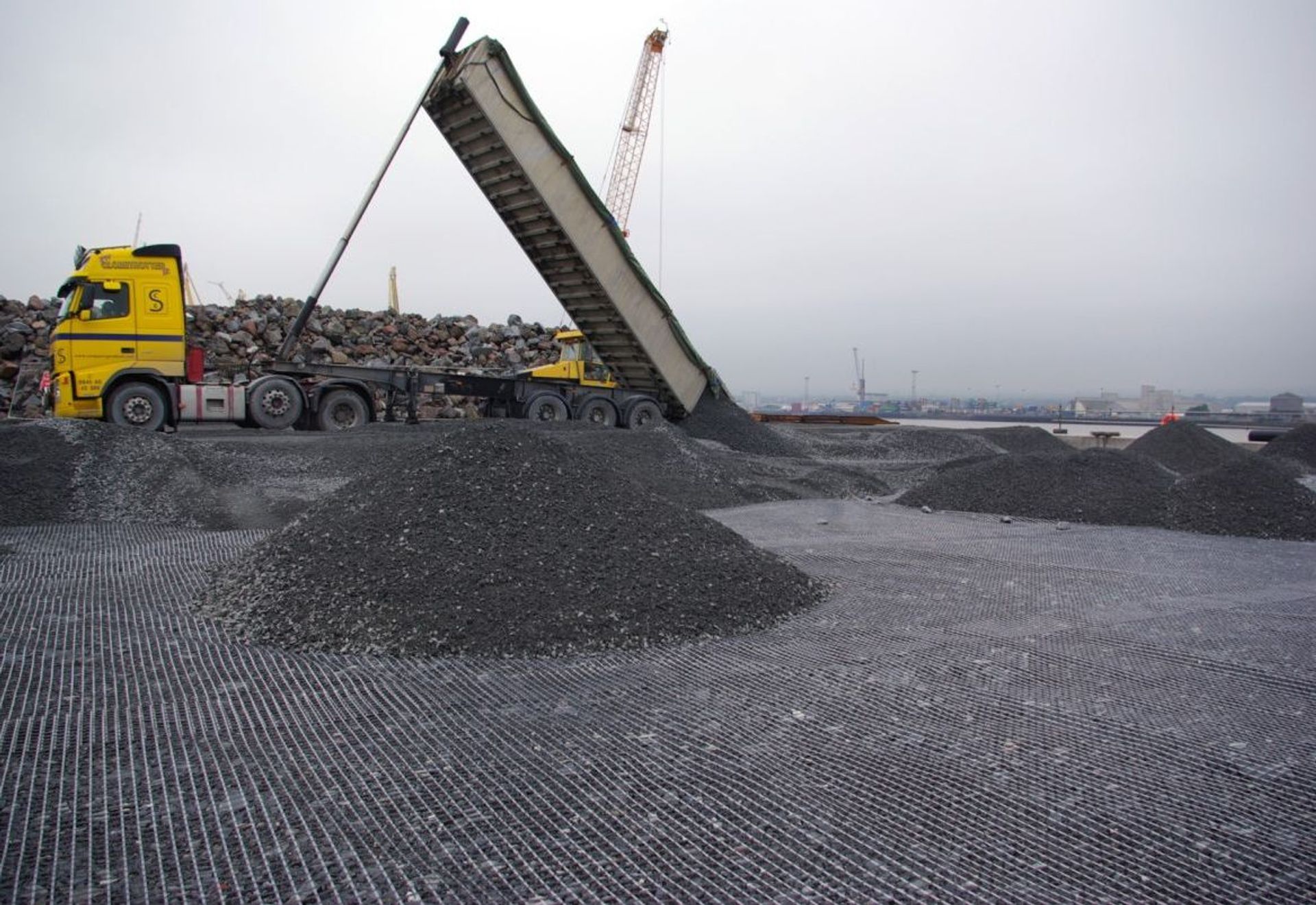
To create a stable platform behind the quay, engineers focused on improving the 50-acre hinterland area. This involved constructing a heavy-duty unbound pavement system using more than 900,000 m² of geosynthetics and importing around 1,000,000 tonnes of aggregate. The scale of material handling and installation reflected the need for a high-performance ground solution capable of supporting repeated heavy loading.
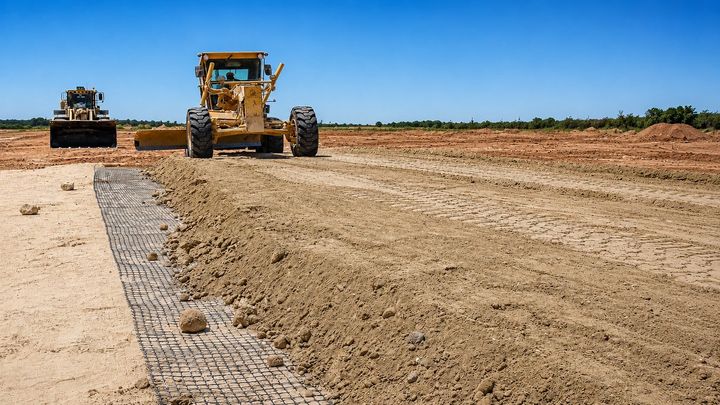
A key element of the design was the construction of a reinforced ground platform with a build-up of up to 2 m in depth. This was achieved using a combination of site-won fill and over 250,000 tonnes of imported stone, placed in controlled layers. Beneath this, a high-strength basal reinforcement layer using Maccaferri Paralink® geogrid was installed approximately 1.3 m below the finished surface.
This geogrid played a critical role in distributing loads, improving bearing capacity, and minimising differential settlement across the site. The use of geosynthetics ensured long-term performance, durability, and cost-efficiency, enabling the transformation of weak, unsuitable ground into a robust working platform.
The result was a successfully engineered quay and logistics hub capable of supporting offshore wind operations, demonstrating the effectiveness of geosynthetic ground stabilisation in large-scale marine infrastructure projects.
Our products for
this Success Story
Get in touch with us
[contactForm_txtSuccessSubmit]