2024
Unguja, Zanzibar
Ministry of Infrastructure, Communication and Transport of Zanzibar
China Civil Engineering Construction Corporation (CCECC)
SMEC
Zanzibar’s First Double-Carriage Flyovers: A Reinforced Earth Solution for Constrained Urban Approach Embankments
Challenge
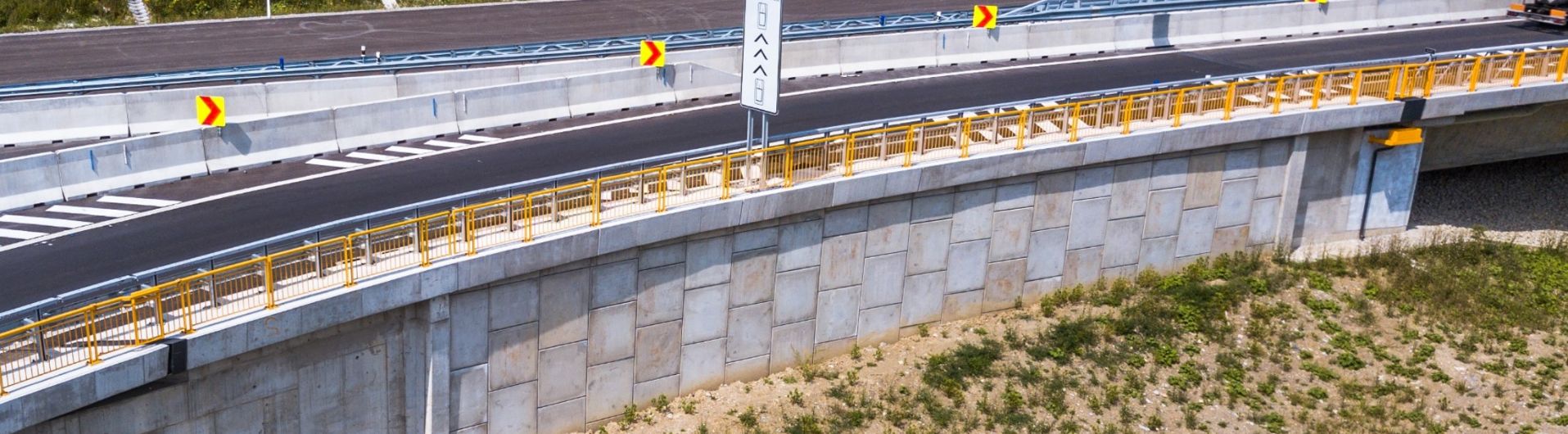
The Zanzibar urban roads upgrade required the delivery of the island’s first double-carriage flyovers at Mwanakwerekwe (Flyover 1) and Adani/Amani (Flyover 2) to support growing transport demand and urban development. In both locations, the critical geotechnical challenge was not the bridge substructure itself, but the need to retain high approach embankments within a constrained urban footprint. The MSE wall heights varied from near zero at the start of the approaches to approximately 9 m at the abutments, while the bridge abutments themselves were piled, leaving the retained approach fills to be supported by the earth-retaining system.
A conventional retaining solution would have increased footprint demand, reduced constructability flexibility and imposed a less efficient solution for long, variable-height urban approaches. The project also had to address:
-
high live traffic surcharge of 20 kN/m² on the reinforced soil block for both flyovers;
-
seismic design demand using 0.1g PGA;
-
barrier impact loading, with 60 kN horizontal impact considered in the design;
-
groundwater encountered at shallow depth, approximately 2 m below ground at Flyover 1 and 1 m below ground at Flyover 2;
-
differential settlement risk associated with variable founding conditions, including coarse deposits and stiff fine-grained strata.
The engineering problem was therefore to provide a retaining system that was:
-
structurally stable under internal, external and overall failure modes,
-
tolerant of long-term settlements,
-
constructible in staged urban works,
-
compatible with shallow approach embankments and bridge interface geometry,
-
and durable for long-term highway service.
Solution
The selected solution was a MacRes mechanically stabilised earth wall system comprising precast concrete facing panels, granular engineered backfill and high-tenacity polyester ParaWeb polymeric strip reinforcement connected to the facing via Para-loops. The system was designed in accordance with BS 8006:2010 using limit state principles and verified independently using MacRes software, Slide limit equilibrium analysis, and Phase2 finite element modelling.
The MacRes system was appropriate because it converted the approach embankments into a reinforced composite mass capable of resisting lateral earth and surcharge loads through soil–reinforcement interaction, while maintaining a near-vertical retained face and a modular construction sequence. The design reports explicitly define the system as concrete facing panels with polymeric strips placed at regular vertical and horizontal spacing in granular backfill, with loads transferred at the face through Para-loops.
The final solution also incorporated foundation improvement layers:
-
Flyover 1: 400 mm basal rockfill or structural fill layer reinforced with Paragrid 150, plus extended bottom and top reinforcement overlap to improve stiffness, settlement control and pavement support.
-
Flyover 2: 600 mm reinforced rockfill layer with Paragrid 150 and geotextile separation to improve bearing performance, reduce differential settlement and improve working conditions near the shallow water table.
Used Products