
CONSTRUCTION OF 21.5KM GANGAPATH EXPRESSWAY FROM DIGHA TO DIDARGANJ
Challenge
Ganga Path, Christened Loknayak Ganga Path in honour of Jayaprakash Narayan, is a 21.5 km Expressway from Digha to Didarganj along southern bank of river Ganga in the city of Patna in the state of Bihar.
Once completed, this will be a major boost for the state’s infrastructure development and would prove a game-changer for the burgeoning city by effectively easing much of its dreadful traffic congestion and will reduce the travel time between Patna’s eastern and western ends from two hours to less than 25 minutes. This would significantly enhance the public awareness in river training works and pave the way for beautification of the city along the stretch.
Out of 21.5 km, Gangapath consists of 13.9km construction of a high embankment (8 m to 15m) over loosely packed sand and fine silt deposits which is susceptible to liquefaction when subjected to ground vibration as it lies in seismic zone IV, which is a high-risk zone and is liable to earthquakes. Furthermore, the city lies largely in the Ganga river basin, which gets affected from flood due to the spill over during monsoons. This also triggered the need to provide a high embankment which can act as flood control bund. In addition, in case of an embankment due to liquefaction, the ground beyond the toe may lose shear strength and suffer lateral flow which may result in the settlement of embankment and progressive cracking of the top crest of the embankment. Hence stability of embankment in short term and settlement of ground in long term ensuring the protection against scour and slope erosion during floods has made the embankment construction more complex.
In general, the bore log data obtained from the project site indicated a brownish grey clayey silt followed by loose to medium dense silty sand, then followed by dense to very dense silty sand till the termination depth.
Solution
Different ground improvement techniques like complete soft soil replacement, usage of PVD’s, are discussed and reviewed for the design of embankment. As the soil is madeup of both silt and clay PVDs may not work effectively and further PVDs require additional surcharge to be placed while complete replacement of soft soil is not feasible due to large area improvement required i.e. bottom width of embankment ranged from 70m to 130m along the complete stretch. Hence Maccaferri’s basal reinforcement technique with replacement of top soil strata is adopted for the project.
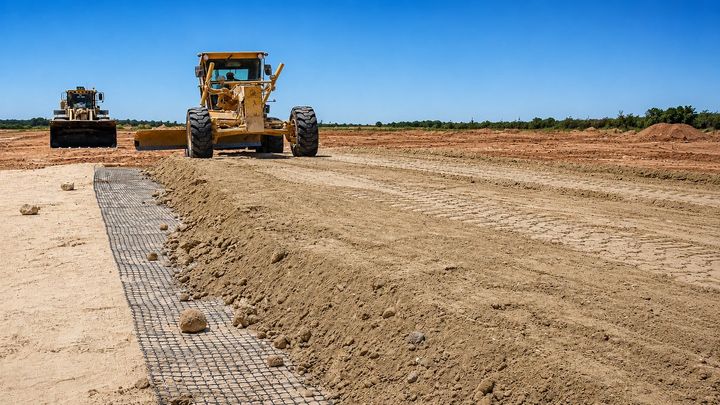
At places where weak soil was found till 9m depth combination of dynamic compaction, replacement and basal reinforcement were adopted. Basal reinforcement was chosen considering its faster installation and construction easiness with improved stability, availability of wide range of strength 50KN/m to 1300KN/m. In order to improve the strength of foundation soil, basal reinforcement using high strength geogrids, with strength varying from 100 to 1300KN/m at 0.2m below ground level is adopted. Replacement was done in the range of 0.5m to 3m. Additional ground improvement methods are suggested where the soil was susceptible to liquefaction. Provision of berms at the toe of the embankment or increasing the berm width or by densification of the subsoil by dynamic compaction, or a combination was suggested so that N value is higher than the liquefiable limits through which extent of damage created by liquefaction can be controlled. In addition, as the expressway alignment is running along the flow of the river Ganga, there are possibilities of erosion of the proposed road embankment which necessitated the need to provide suitable erosion control and bank protection works.
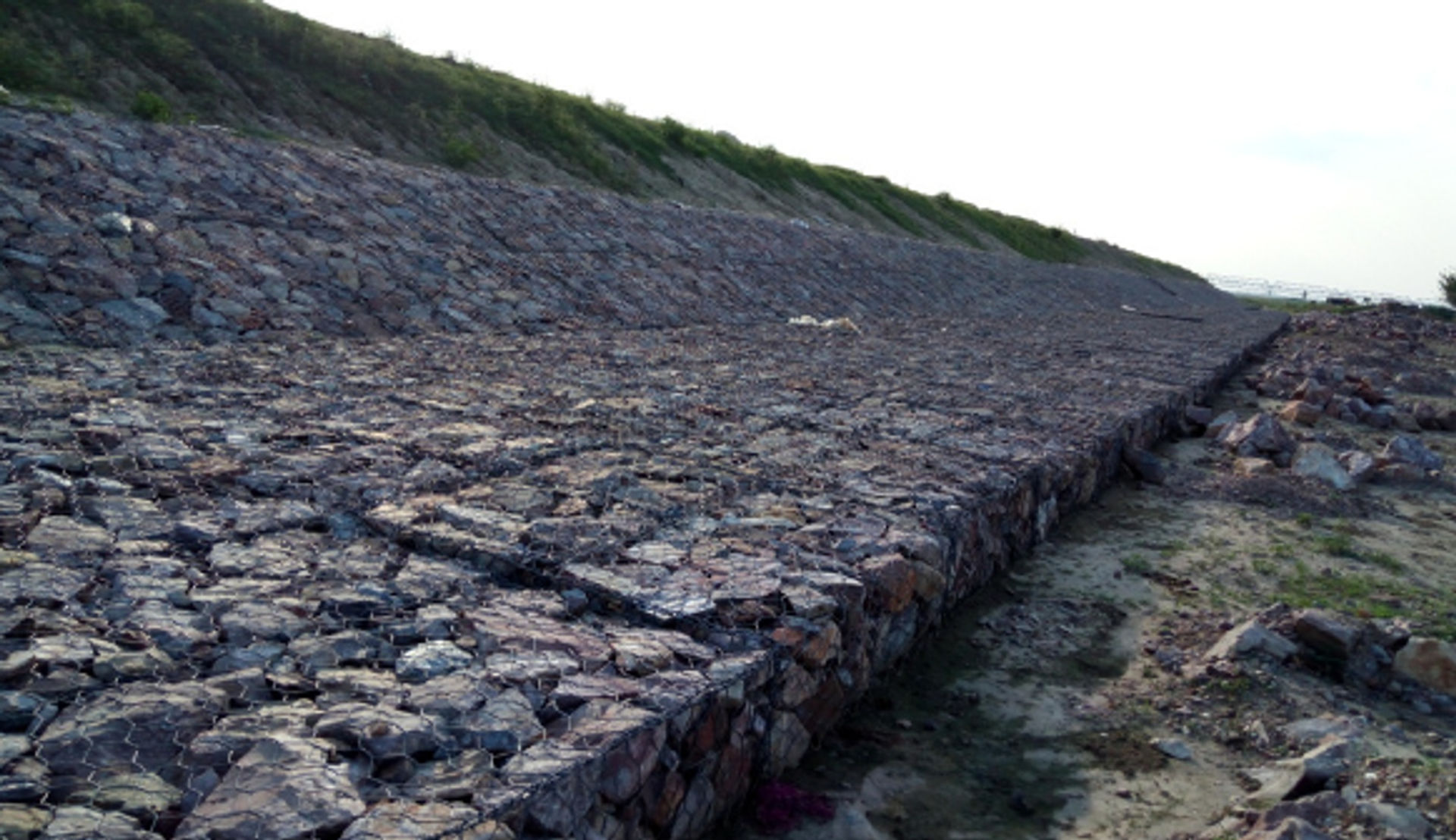
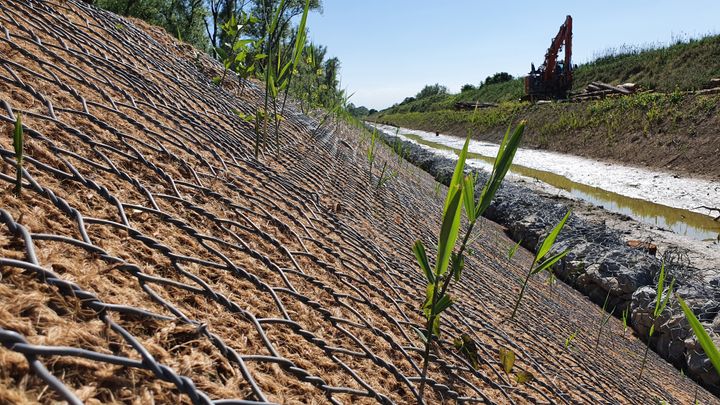
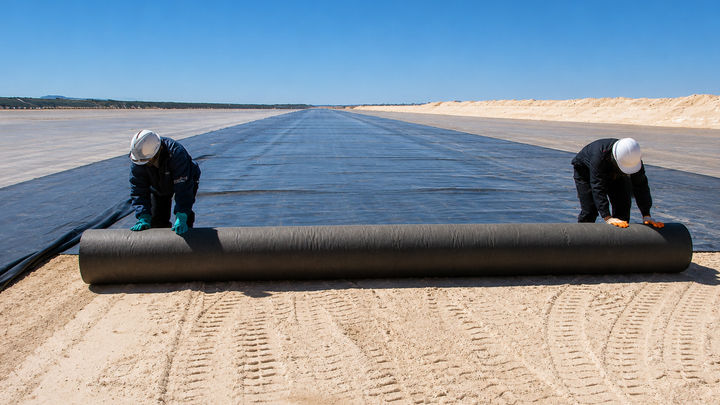
Initially conventional rirap was considered for bank protection, as the project location has ban on mining, boulders of required size for Riprap are scarce and are also costly. Thickness using Riprap was coming out as 1.5m. Protection works using renomattresses was finalised as the thickness was less than half (compared to stone pitching), stones of smaller size can be used and complete protection works using mattresses is monolithic and flexible. Using Renomattress cost of bank protection was reduced by 25- 35%. Keeping this in view, for embankment protection a launching apron of length 20m with 0.5m thick gabion mattress and on slopes 0.23 m (till HFL) or 0.17 m (from HFL to berm level) thick Revet mattress was suggested. Further, to prevent erosion along the slope biodegradable mat was suggested above the berm. In addition, to prevent erosion of fines beneath the mattresses, a geotextile filter/separator, was also recommended.
Our products for
this Success Story
Get in touch with us
[contactForm_txtSuccessSubmit]