


HANDSWORTH CUTTING
Challenge
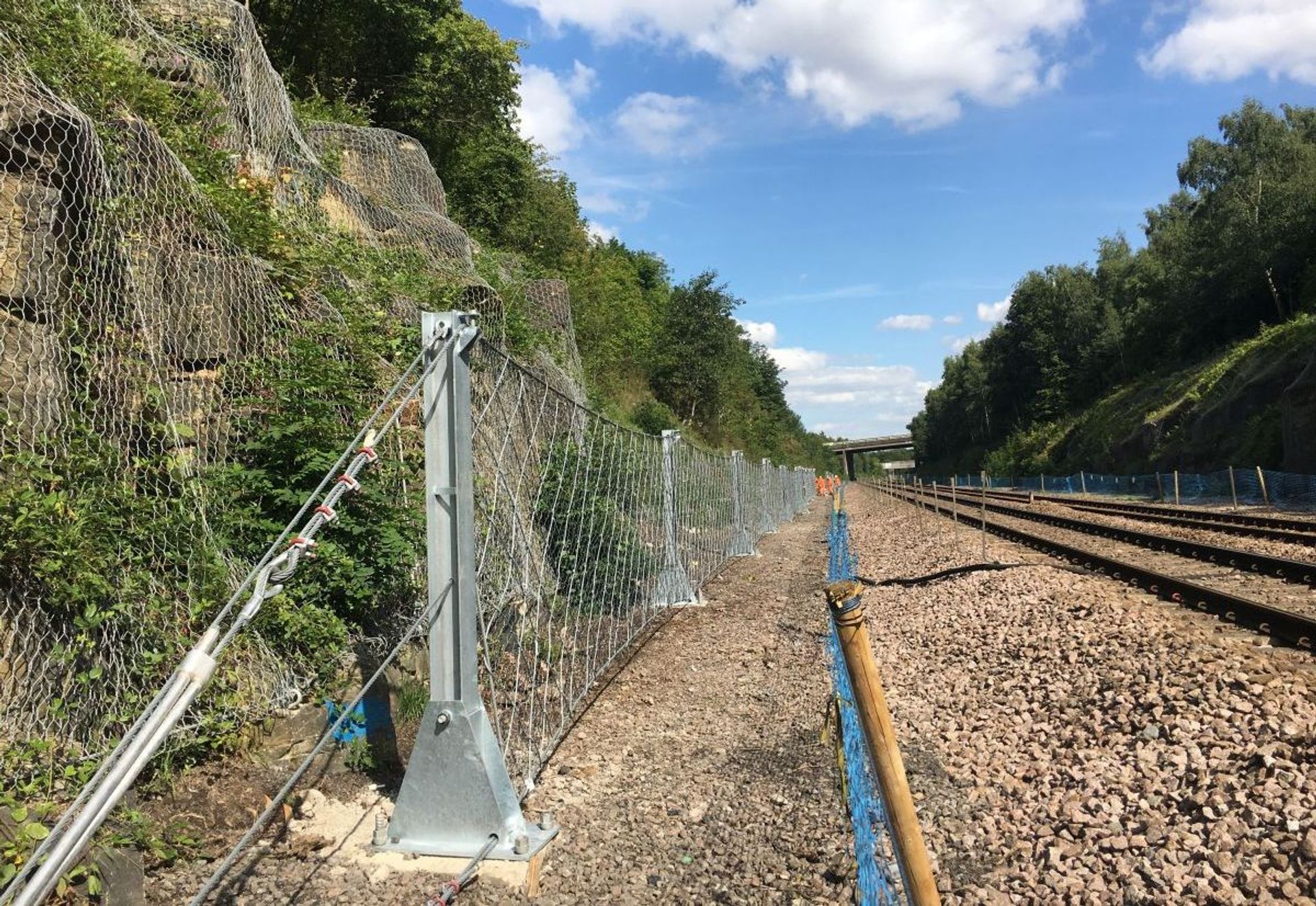
Handsworth Cutting, on the Deepcar to Cleethorpes line, was originally constructed as a tunnel known locally as Darnall Tunnel, 3/4m east of Darnall station near Sheffield. When opened to passengers in February 1849, the railway consisted of only two lines. Due to an increase in coal traffic to Immingham Docks during the early 20th century, the railway capacity was increased by adding two good lines. At this time Darnall tunnel presented a bottleneck preventing the construction of the goods lines and requiring its signal box to control train movements through the tunnel. To allow the construction of the goods lines, the tunnel was decommissioned and demolished in 1912, creating what is now known as the Handsworth Rail Cutting. As coal exports decreased, along with the associated traffic, the outer goods lines were removed leaving a cess 5m - 6m wide. This ‘wide cess’ would prove pivotal to the CMLs method of work during the installation of the rock fall protection scheme. The rail cutting which comprises several distinct slope forms cut through with coal measures, bands of sandstone and siltstone/mudstone. The local geology, along with debris left by the explosives used in the decommissioning of the Darnall tunnel, has led to unstable cutting faces. The maximum height of the cutting is approximately 25m, with slope angles of approximately 70°- 80° degrees within the rock slopes, and 35° - 50° within the soil slopes. With a history of rock falls throughout the cutting and records of a derailment around 1996, this stretch of track posed a significant risk to an operational railway for Network Rail and its users.
Solution
Maccaferri 500kJ RMC 050 ICAT/2 and 100kJ RB100 barriers were selected as suitable options and functions by transferring rockfall impact energies to lateral cables and the barrier bases. Indeed, the ICAT/2 barrier does not require any uphill support cables, reducing installation time. The barriers were designed and constructed to suit the cutting cess ground conditions, which included ballast over variably loose or disturbed horizons of fill and weathered insitu materials, underlain by more competent rock.
Our products for
this Success Story
Get in touch with us
[contactForm_txtSuccessSubmit]