
RIVERVIEW MINING SUBSIDENCE
Year
2020
Location
RIVERVIEW - QUEENSLAND - Australia
Client
CALTEX SERVICE STATION
Challenge
A service station was proposed to be built in Westphalen Drive, Riverview. A previous mine subsidence report identified the presence of historical mining activity beneath the site and the potential for sinkholes to occur. Development in subsidence prone areas is an attractive option for developers due to the lands relatively low cost. From previous work conducted at the site, it was concluded that from the results of the sonar, the sizes of the workings appear reasonably consistent with the mine workings plans and that designing for a 6m diameter void over a single bord or a 10m diameter void over a bord intersection appeared to be a reasonable approach. This previous work assessed the location and nature of the bord and pillar workings, and that the significant subsidence risks comprised sinkhole development due to collapse of bords. The building foundations were designed by the structural engineer as structural rafts to span the potential sinkholes. Other key features that are settlement sensitive (i.e. fuel storage tanks) have been located over stable areas of the site directly underlain by coal pillars.
Solution
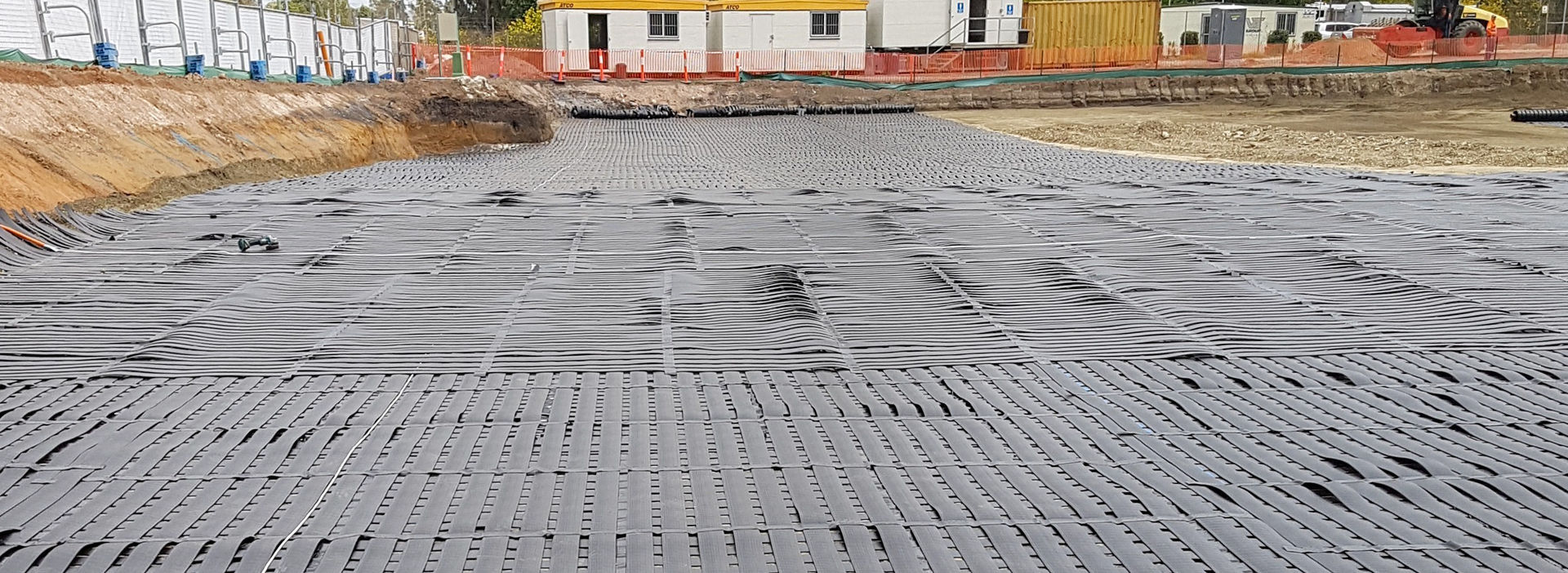
Commonly used remediation measures for subsidence caused by voids are wide-scale grouting of the underground cavities, providing structural bridging using a reinforced concrete slab or raft and deep foundations (piles or piled raft). These remediation methods are not economically viable for low rise buildings or infrastructure developments. Flexible bridging platforms consisting of high strength geosynthetic reinforcement are a cost-effective, viable option. The premise of this approach is not to prevent any surface deformation occurring but to maintain the serviceability of the surface until remediation measures can be undertaken. Douglas Partners undertook analysis and design of a geogrid reinforced fill bridging platform to accommodate the anticipated sinkhole subsidence. The analysis was carried out using finite element software Plaxis 2D and was based on the British Standard BS 8006-1:2010. A double-layer system design was selected, one that utilised Maccaferri’s high-performance Paralink®1000 kN geogrid in longitudinal and transversal layers.
Get in touch with us
[contactForm_txtSuccessSubmit]